Food and History
A Bird of Courage
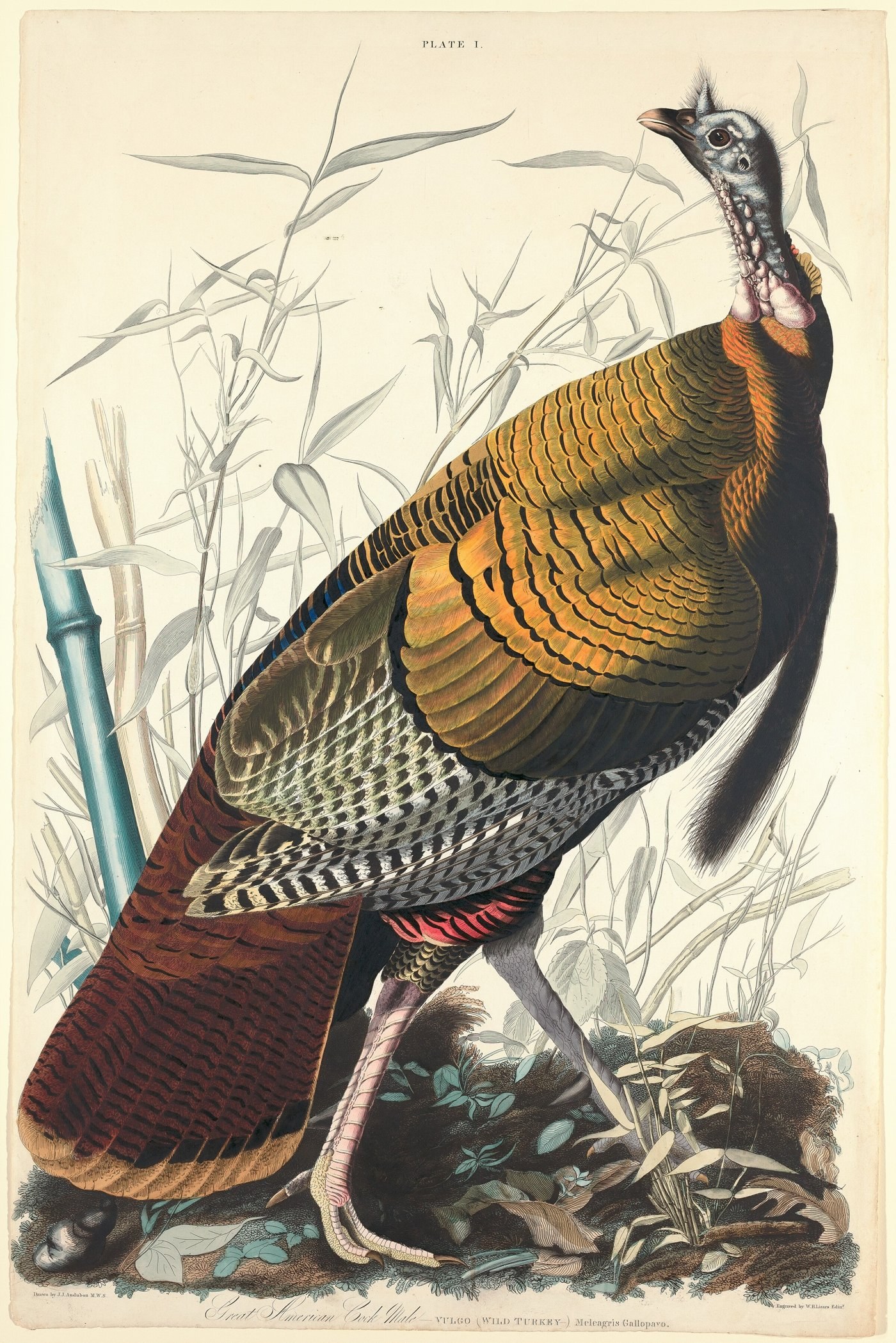
Thanksgiving is Thursday, and millions of families across the country will cook a turkey (unless they are cooking from the White House Cook Book’s squirrel-and-mutton menu). Last Thanksgiving, by the National Turkey Federation’s estimate, Americans ate nearly 30 million of them.1 Turkeys are the centerpiece of most Thanksgiving tables, and they also feature prominently in Founding Fathers fiction. The best-known (and apocryphal) story says Benjamin Franklin wanted the turkey as the national bird.
The truth isn’t quite so delicious, but it’s still a little spicy. On January 26, 1784, Franklin was in Passy, France, a village outside Paris. He moved there in 1777 as an American envoy and became the first American minister received by any foreign court in 1779.2 He was answering a packet of newspapers sent from Philadelphia by his daughter, Sally Bache.3
The papers carried news of the founding the previous May of the Society of the Cincinnati, a club of Continental Army officers formed to keep their wartime fellowship alive and to help members and their families in need. It took its name from Cincinnatus, the Roman who left his farm to lead his republic and went back to it when the crisis passed.4 George Washington was its first president general. Franklin didn’t like it anyway. He objected to the inheritance of membership. The Articles of Confederation had rejected ranks of nobility, he wrote, yet private persons now meant to “form an order of hereditary Knights.” Let the officers’ fathers and mothers wear the badge, he suggested, instead of their children.5
Others had complained that the eagle on the badge looked more like a turkey. Franklin was not displeased. “For my own part I wish the bald eagle had not been chosen as the representative of our country,” he wrote to Sally. “He is a bird of bad moral character.” The eagle stole fish from the fishing hawk and fled from a kingbird no bigger than a sparrow. The turkey was “a much more respectable bird, and withal a true original native of America,” and “a bird of courage” that would charge a British grenadier who entered its farmyard “with a red coat on.”6
That is the whole case for the turkey, made in a private letter to his daughter. The Smithsonian’s National Zoo and Conservation Biology Institute reads the letter mainly as a jab at the bald eagle.7 Congress had settled the national seal matter two years earlier, when it adopted Charles Thomson’s eagle for the Great Seal in 1782. Franklin’s own seal design, offered in 1776 on a committee with John Adams and Thomas Jefferson, showed Moses parting the Red Sea, with the motto “Rebellion to tyrants is obedience to God.”8 Franklin never actually proposed the turkey as a national symbol. He just thought the Cincinnati were a bunch of turkeys.
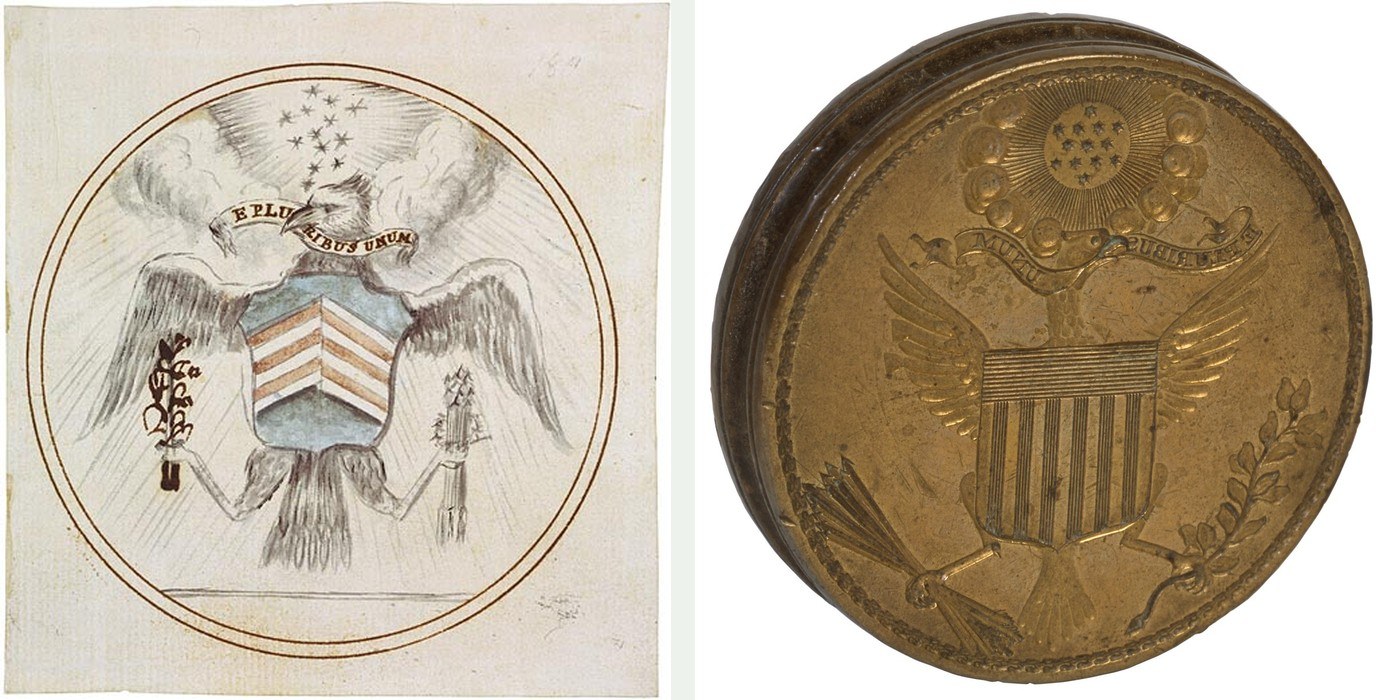
Franklin also got the bird’s history wrong, but that’s a story for Friday. Two centuries later a president pardoned a North Carolina turkey named Courage.9 Franklin would have liked the name. That one is for Wednesday.
Notes
- National Turkey Federation, “94% of Americans Plan to Celebrate Thanksgiving and Turkey Remains the Star of the Table,” news release, November 4, 2025, https://www.eatturkey.org/2025/11/04/94-of-americans-plan-to-celebrate-thanksgiving-and-turkey-remains-the-star-of-the-table/. The federation’s August 2025 online survey of 1,000 consumers, conducted by 210 Analytics, found that 87 percent of those who celebrate say turkey is part of their holiday meal most years. ↩
- “Benjamin Franklin,” Office of the Historian, U.S. Department of State, accessed November 14, 2026, https://history.state.gov/departmenthistory/people/franklin-benjamin; “Fighting for Independence: An Alliance with France,” National Museum of American Diplomacy, U.S. Department of State, accessed November 19, 2026, https://diplomacy.state.gov/online-exhibits/diplomacy-is-our-mission/security/fighting-for-independence-an-alliance-with-france/; “Franklin and Chaumont: Agreement about Board at Passy,” [c. January 28, 1777], in The Papers of Benjamin Franklin, vol. 23, Founders Online, National Archives, https://founders.archives.gov/documents/Franklin/01-23-02-0156. ↩
- “Sarah Franklin Bache,” The Papers of Benjamin Franklin, accessed November 14, 2026, https://franklinpapers.org/bio?id=42; “Franklin Court,” Independence National Historical Park, National Park Service, accessed November 14, 2026, https://www.nps.gov/inde/learn/historyculture/places-franklincourt.htm. ↩
- “Society of the Cincinnati,” NCpedia, State Library of North Carolina, accessed November 15, 2026, https://www.ncpedia.org/society-cincinnati; Adam E. Zielinski, “The Society of the Cincinnati: The Nation’s Oldest Patriotic Organization,” American Battlefield Trust, updated October 18, 2024, https://www.battlefields.org/learn/articles/society-cincinnati-nations-oldest-patriotic-organization; “General Meeting of the Society of the Cincinnati [Editorial Note],” in The Papers of George Washington, Confederation Series, vol. 1, Founders Online, National Archives, https://founders.archives.gov/documents/Washington/04-01-02-0236-0001 (members subscribed one month’s pay for the support of needy officers and their families). ↩
- Benjamin Franklin to Sarah Bache, January 26, 1784, in The Papers of Benjamin Franklin, vol. 41, Founders Online, National Archives, https://founders.archives.gov/documents/Franklin/01-41-02-0327; text consulted in the American Revolution Institute transcription, https://www.americanrevolutioninstitute.org/wp-content/uploads/2020/12/Benjamin-Franklin-to-Sarah-Bache-January-26-1784.pdf. ↩
- Franklin to Bache, January 26, 1784. ↩
- Smithsonian’s National Zoo and Conservation Biology Institute, “10 Turkey Facts to Gobble Up This Thanksgiving,” November 13, 2026, https://nationalzoo.si.edu/animals/news/10-turkey-facts-gobble-thanksgiving. ↩
- “The Great Seal,” National Museum of American Diplomacy, U.S. Department of State, accessed November 19, 2026, https://diplomacy.state.gov/the-great-seal/. ↩
- White House Historical Association, “Thanksgiving at the White House,” accessed November 19, 2026, https://www.whitehousehistory.org/press-room/press-timelines/thanksgiving-at-the-white-house. ↩