Food and History
The 1796 Turkey
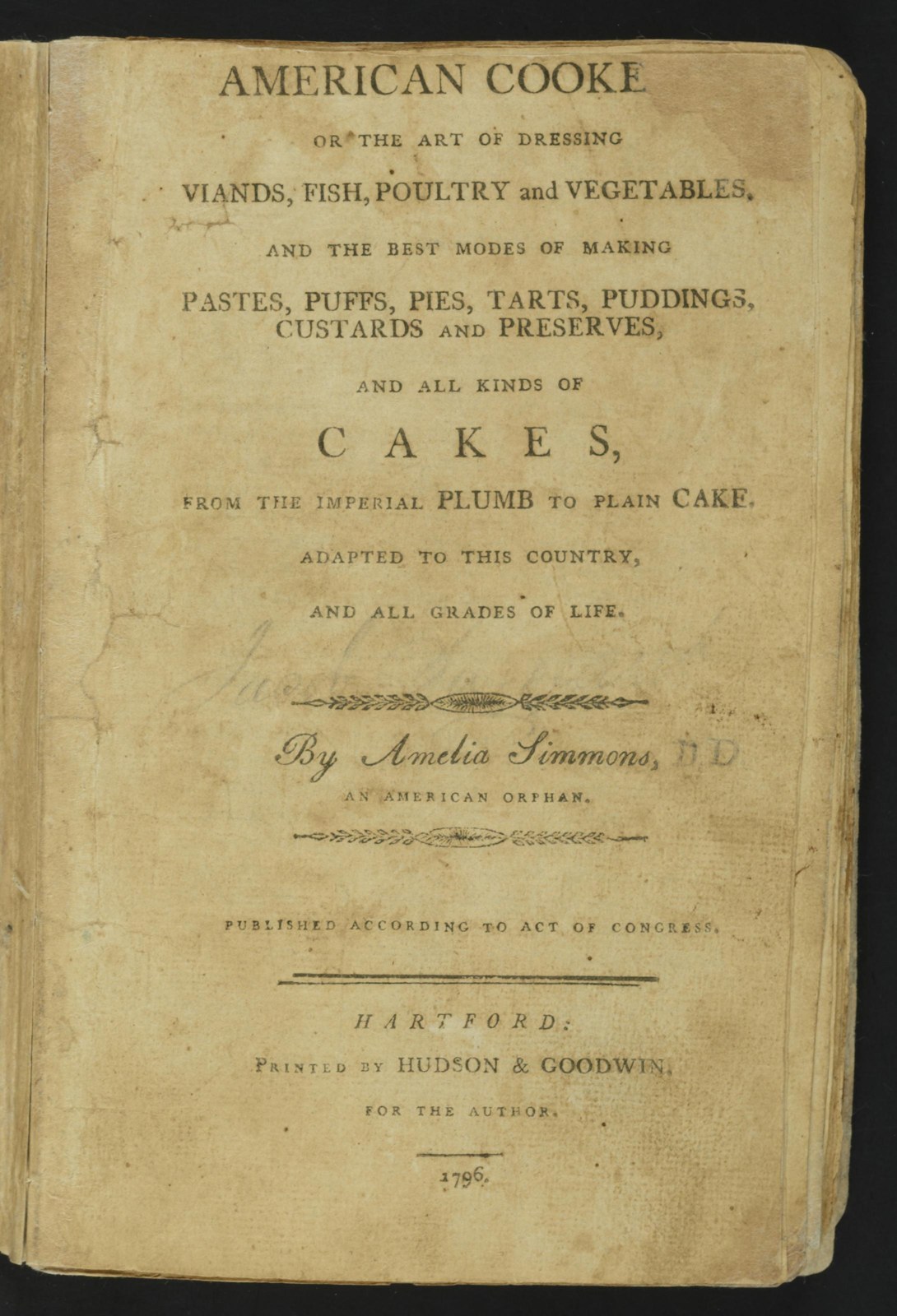
As we plan our menus this week, like with everything else in life, we can learn a lot from our history. In 1796, for example, Amelia Simmons, who signed herself “an American Orphan,”1 became the first cookbook author known to suggest serving cranberry sauce with turkey.2
The suggestion is in American Cookery, the first cookbook of American authorship printed in the United States, which was published in Hartford, Connecticut. Only four copies of the original edition are known to have survived.3
To set the scene: 1796 was the last full year of George Washington’s presidency, twenty years after independence. That September, Washington told the country in a newspaper letter that he would not seek a third term. The Senate still reads that Farewell Address aloud every year.4 The first contested presidential election followed, and it made John Adams president and his rival, Thomas Jefferson, vice president.5
Americans, as the Smithsonian puts it, “sought a national identity,” and a cookbook was one way to claim one. Historian Mary Tolford Wilson called Simmons’s book “another declaration of American independence.”5 Simmons promised recipes “adapted to this country, and all grades of life” and had the book printed “for the Author,” which usually meant she paid for it herself.1 Little else is known about her.6 Demand kept the book in print for thirty-five years, until about 1831,6 and plagiarized editions circulated alongside the real ones.5
What made it American was the pantry. Simmons cooked with cornmeal. She appears to have coined the word “slapjacks,” called a mix of lard and butter “shortening,” and spelled the Dutch koekje as “cooky.”6 Her “Johny Cake, or Hoe Cake” recipe starts simply: “Scald 1 pint of milk and put to 3 pints of Indian meal, and half pint of flower—bake before the fire.”1
Her turkey is close to ours. “One pound soft wheat bread, 3 ounces beef suet, 3 eggs, a little sweet thyme, sweet marjoram, pepper and salt, and some add a gill of wine; fill the bird therewith and sew up, hang down to a steady solid fire, basting frequently with salt and water, and roast until a steam emits from the breast, put one third of a pound of butter into the gravy, dust flour over the bird and baste with the gravy; serve up with boiled onions and cramberry-sauce, mangoes, pickles or celery.”1 On the same page she gives a second stuffing that is closer still: a grated wheat loaf, butter, salt pork, eggs, sweet marjoram, summer savory, parsley, and sage.1
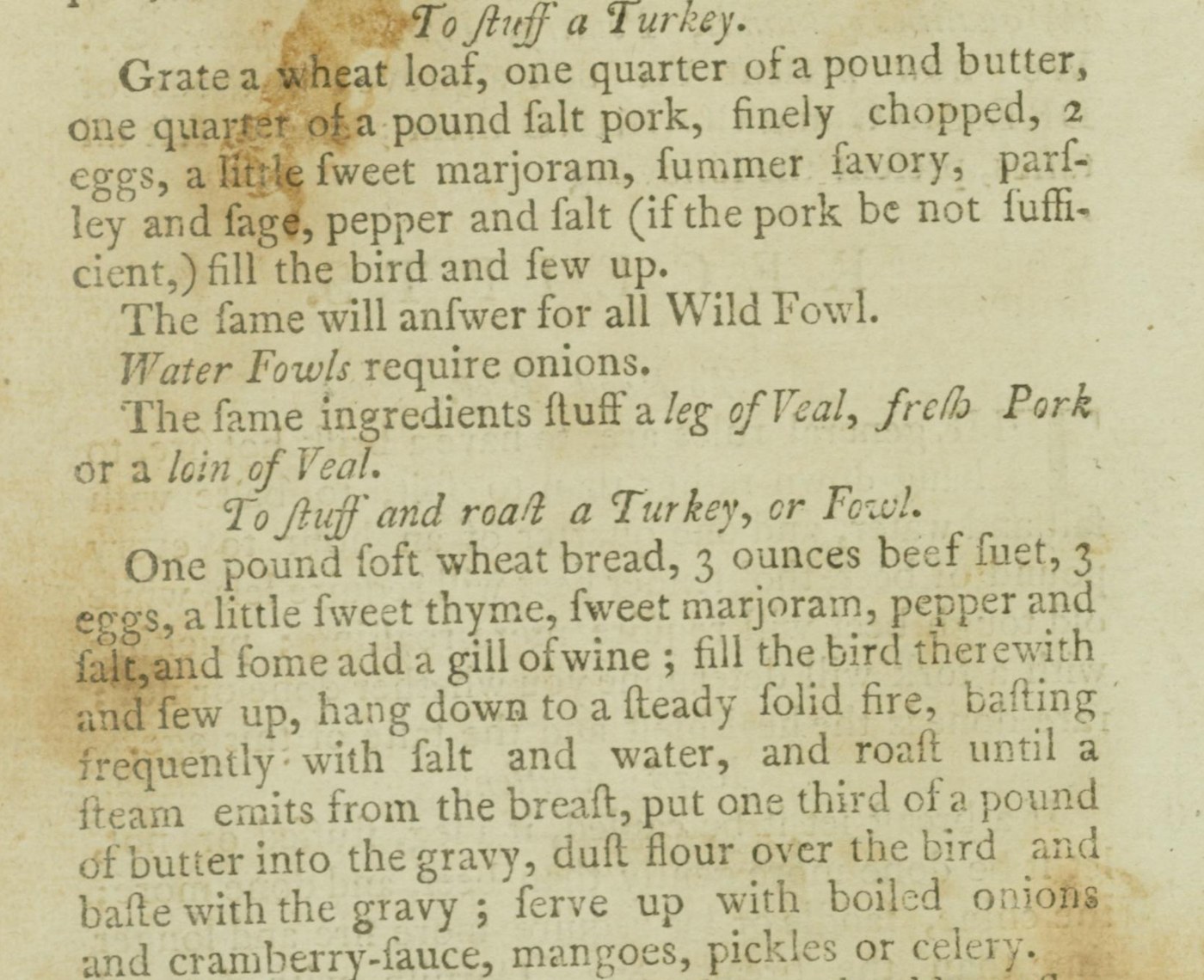
Simmons gives no recipe for cranberry sauce, but American Heritage calls her book “evidently the first cookbook to recommend it as an accompaniment for turkey.”2 The mangoes are not what you think. They were most likely pickled melons.1
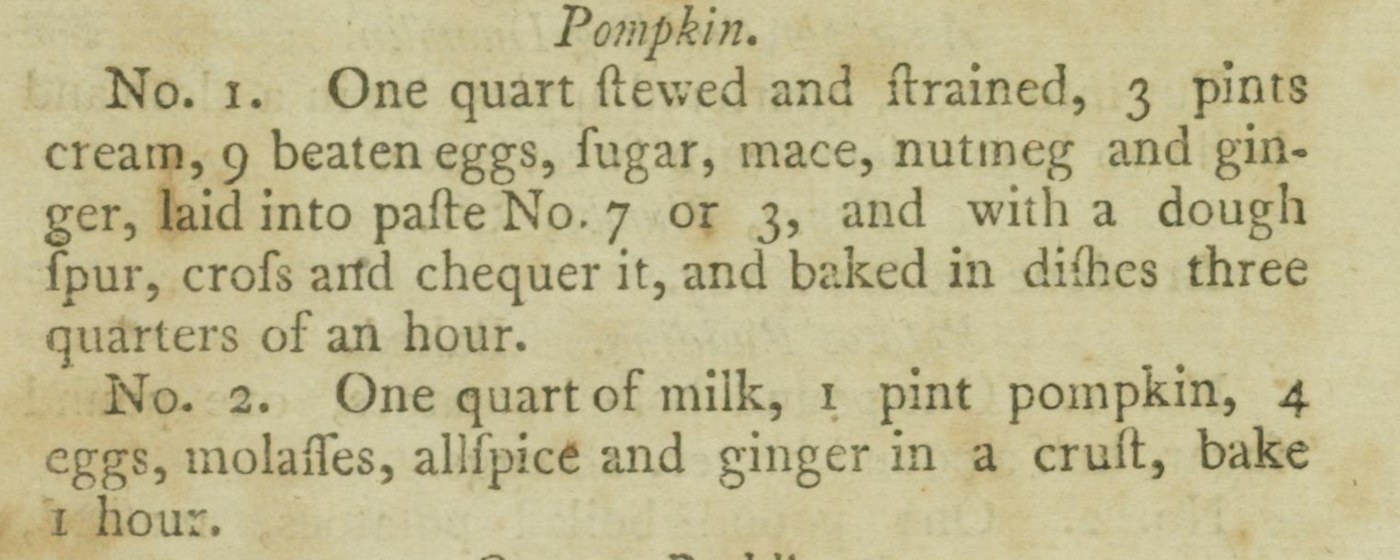
Dessert is familiar too. Simmons gives two pumpkin pies, spelled “Pompkin.” The richer one is “One quart stewed and strained, 3 pints cream, 9 beaten eggs, sugar, mace, nutmeg and ginger,” baked three quarters of an hour. The plainer one is “One quart of milk, 1 pint pompkin, 4 eggs, molasses, allspice and ginger in a crust, bake 1 hour.”1 The second is most of a modern pumpkin pie, sweetened with molasses.
Simmons still has fans in the kitchen. José Andrés, who runs seven restaurants in Washington that we love, told NPR that while other books of her day copied English texts, she “put her own take on those recipes,” and he singled out her pompkin.10
If stuffing a turkey worries you, you’re in good company. In the 2001 Thanksgiving episode of The West Wing, “The Indians in the Lobby,” President Bartlet calls the Butterball hotline with questions about cooking his stuffing and does his best not to be identified by the hotline staff.11 It’s time well spent if you can watch it. It streams on HBO Max and Netflix.12
For the glass, pour something older than the republic. The Laird family of New Jersey made applejack, a brandy distilled from apples, in colonial days, and George Washington wrote to them asking for their recipe for “cyder spirit.”13 You can still buy Laird’s Applejack today.14 Shake 2 ounces of applejack with 1 ounce of lime juice and half an ounce of grenadine and you have a Jack Rose. If that sounds familiar, you’re probably remembering the cocktail that Jake Barnes drank at the Hôtel de Crillon in The Sun Also Rises.15
Simmons trusted her readers with a fire and a gill of wine. President Bartlet needed a hotline. On Thursday, split the difference: make her stuffing, use a thermometer, and pour a Jack Rose.
Notes
- Amelia Simmons, American Cookery (Hartford: Hudson & Goodwin, 1796), title page; “Johny Cake, or Hoe Cake”; “To stuff a Turkey”; “To stuff and roast a Turkey, or Fowl”; “To pickle or make Mangoes of Melons”; “Pompkin”; “Puff Pastes for Tarts”; Project Gutenberg, https://www.gutenberg.org/ebooks/12815; page images, Library of Congress, Rare Book and Special Collections Division, https://www.loc.gov/item/96126967/; “For the Author” explained in “What America’s First Cookbook Says” (see note 5). ↩
- Martha C. Brown, “Of Pearl Ash, Emptins, and Tree Sweetnin’,” American Heritage 32, no. 5 (August/September 1981), https://americanheritage.com/node/54335. ↩
- “American Cookery,” American Treasures of the Library of Congress, archived January 14, 2009, https://webarchive.library.unt.edu/eot2008/20090114025317/http://www.loc.gov/exhibits/treasures/tri054.html. ↩
- Senate Historical Office, introduction to Washington’s Farewell Address to the People of the United States (U.S. Senate), accessed November 18, 2026, https://www.senate.gov/artandhistory/history/resources/pdf/Washingtons_Farewell_Address.pdf. ↩
- “What America’s First Cookbook Says about Our Country and Its Cuisine,” Smithsonian Magazine, accessed November 15, 2026, https://www.smithsonianmag.com/history/what-americas-first-cookbook-says-about-our-country-its-cuisine-180967809/; Harrison W. Mark, “US Presidential Election of 1796,” World History Encyclopedia, accessed November 14, 2026, https://www.worldhistory.org/US_Presidential_Election_of_1796/. ↩
- Gregg Mangan, “Amelia Simmons Adds a Uniquely American Flavor to Cooking,” Connecticut History, November 27, 2020, https://connecticuthistory.org/?p=19161. ↩
- Charles H. Steffani, “History of Horticulture in Dade County,” Proceedings of the Florida State Horticultural Society 67 (1954): 233–36, https://www.avocadosource.com/Journals/FSHSP/FSHSP_VOL_67_PG_233-236_1954.pdf; Noris Ledesma, “The History of Mangos in South Florida,” Fairchild Tropical Botanic Garden, accessed November 15, 2026, https://fairchildgarden.org/visit/the-history-of-mangos-in-south-florida/. ↩
- Amelia Simmons, American Cookery, introduction by Melissa Clark, American Antiquarian Cookbook Collection (Andrews McMeel Publishing, October 16, 2012), Simon & Schuster listing (reproduced by permission from the American Antiquarian Society’s copy), https://www.simonandschuster.com/books/American-Cookery/Amelia-Simmons/9781449423131. ↩
- Melissa Clark, “Ultimate Pumpkin Pie,” NYT Cooking, reprinted as “Recipe: Ultimate Pumpkin Pie, from New York Times Cooking,” CBS News, November 19, 2021, https://www.cbsnews.com/news/recipe-ultimate-pumpkin-pie-from-new-york-times-cooking; Melissa Clark, “Brandied Pumpkin Pie,” NYT Cooking, reprinted as “Recipe: Melissa Clark’s Brandied Pumpkin Pie,” CBS News, November 21, 2025, https://www.cbsnews.com/news/recipe-melissa-clarks-brandied-pumpkin-pie. ↩
- “Oyster Ice Cream: A Thanksgiving Tradition Mark Twain Could Get Behind,” NPR, November 23, 2011, https://www.npr.org/sections/thesalt/2011/11/23/142669973/oyster-ice-cream-a-thanksgiving-tradition-mark-twain-could-get-behind (NPR dates the book to 1798; the first edition is 1796); restaurant count from “Washington, D.C.,” José Andrés, accessed November 18, 2026, https://www.joseandres.com/washington-dc/ (lists barmini, Bazaar Meat, China Chilcano, Jaleo, minibar, Oyamel, and Zaytinya), and “Bazaar Meat by José Andrés Opens Today in Washington, DC,” PoPville, March 19, 2026, https://www.popville.com/2026/03/bazaar-meat-jose-andres-open-washington-dc-waldorf-astoria/ (Bazaar Meat replaced the Bazaar). ↩
- “The Indians in the Lobby,” The West Wing, season 3, episode 7, TheTVDB, accessed November 14, 2026, https://www.thetvdb.com/series/the-west-wing/episodes/89383; “3.07: The Indians in the Lobby,” The West Wing Weekly (transcript), https://westwingweekly.squarespace.com/s/307-The-Indians-in-the-Lobby.pdf. ↩
- “The West Wing,” AmchiMovie, availability checked November 18, 2026, https://www.amchimovie.com/us/series/the-west-wing; streaming availability changes. ↩
- “Cold Weather and Apples Were Two Things the American Colonies Had. Industrious Scottish Immigrants Turned Them Into a Favorite Spirit,” Smithsonian Magazine, accessed November 18, 2026, https://www.smithsonianmag.com/arts-culture/cold-weather-apples-american-colonies-industrious-scottish-immigrants-turned-them-into-favorite-drink-180987466/. ↩
- “History,” Laird & Company, accessed November 14, 2026, https://www.lairdandcompany.com/history. ↩
- Rebecca Rupp, “Applejack. For When Hard Cider Just Isn’t Strong Enough,” National Geographic, October 19, 2015, https://www.nationalgeographic.com/culture/article/applejack-for-when-hard-cider-just-isnt-strong-enough. ↩