Food and History
The Turkey's Round Trip
Benjamin Franklin called the turkey “a true original native of America.” In the same 1784 letter, he told his daughter that the first turkeys seen in Europe came from Canada with the Jesuits.1 He was right about the first part and wrong about the second. The bird on yesterday’s table took a longer road.
Scientists at the Smithsonian’s National Zoo and Conservation Biology Institute note that Indigenous hunters in North America have pursued wild turkeys since the close of the last Ice Age. They trace the domestic turkey back two thousand years to today’s Mexico, where people tamed it to use its feathers for clothing and ceremonial dress.2 The Spanish carried the Mexican bird home in the 1500s. They took breeding stock, not souvenirs. According to Colonial Williamsburg, King Ferdinand ordered every ship returning from the New World to bring ten turkeys, “half males, and the other half females.”3 From Spain the bird moved across Europe, and European settlers later carried it back to North America.2 The turkey on an American table made a transatlantic round trip.
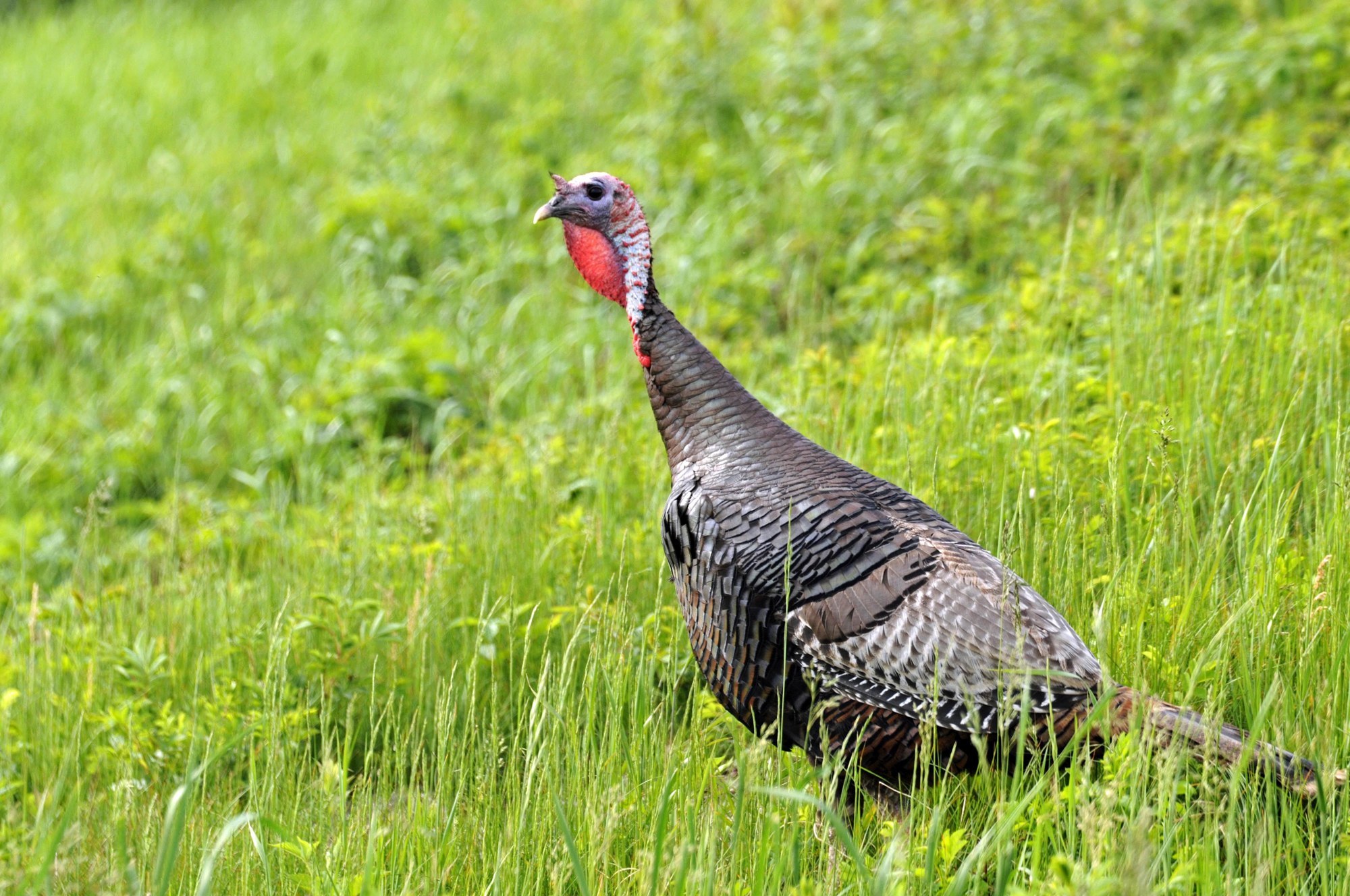
Then it changed color. Wild turkeys are bronze. Plucked, a bronze bird shows dark specks where the pinfeathers were. In 1936, a survey for the National Association of Food Chains found shoppers wanted birds “free from dark-colored pinfeathers.” A U.S. Department of Agriculture team at Beltsville, Maryland, led by Stanley Marsden, bred the Beltsville Small White, whose white pinfeathers are, as Marsden put it, “inconspicuous.” By 1965, most of the market belonged to a heavier bird, the Broad-Breasted White.4 Of the roughly 195 million turkeys American farms raise each year, all but a fraction of 1 percent are that breed.2
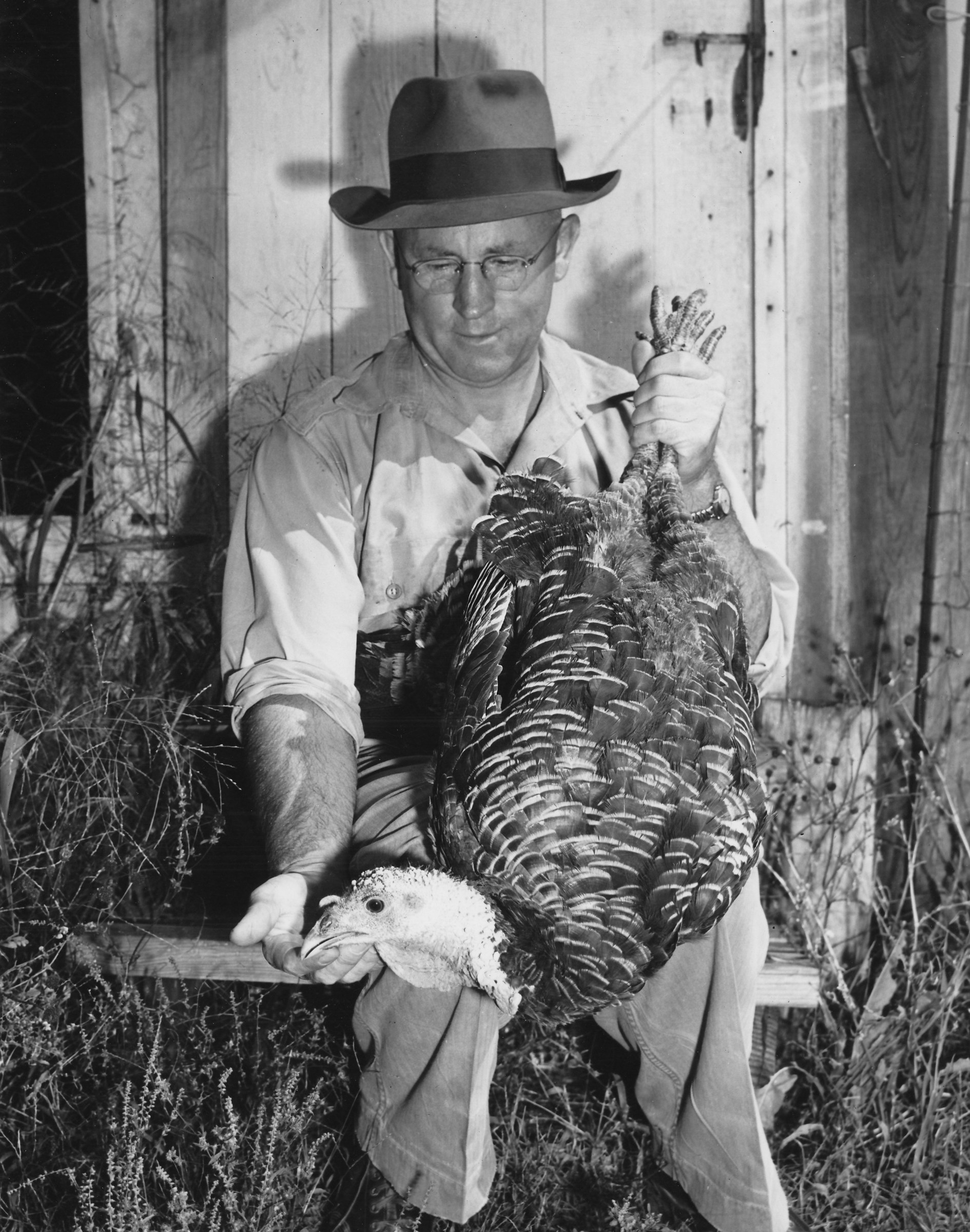
The wild bird fell hard in the meantime. By the mid-1930s, after years of unregulated hunting and forest clearing, only about 130,000 were left.2 The Pittman-Robertson Act of 1937 sends a federal excise tax on guns and ammunition to state wildlife agencies, and the wild turkey is among the species it helped restore.15 When the National Wild Turkey Federation was chartered in Fredericksburg, Virginia, in 1973, about 1.3 million wild turkeys remained.16 The zoo now puts the count at 6.5 to 6.7 million.2
You can see the original color in Washington, D.C. The zoo keeps a small flock of Standard Bronze turkeys on the Bird Plateau, the outdoor yard beside its Bird House, which reopened in March 2023. Inside, songbirds fly among coffee plants in a farm aviary, also worth a look.17 The turkeys are the color the farm bird gave up, and they are not on anyone’s menu. Walk off the leftovers this weekend and look one in the eye.
Outside Boston, the wild bird has made itself at home. Massachusetts tells residents who meet an aggressive turkey to stand their ground, make themselves look bigger, and turn a hose on it.18 In Cambridge, residents have asked the city for help with birds they say are harassing them.19 Franklin promised that a turkey would attack a British grenadier who invaded its farmyard “with a red coat on.”1 In Massachusetts, the turkeys no longer wait for the red coat.
Notes
- Benjamin Franklin to Sarah Bache, January 26, 1784, in The Papers of Benjamin Franklin, vol. 41, Founders Online, National Archives, https://founders.archives.gov/documents/Franklin/01-41-02-0327; text consulted in the American Revolution Institute transcription, https://www.americanrevolutioninstitute.org/wp-content/uploads/2020/12/Benjamin-Franklin-to-Sarah-Bache-January-26-1784.pdf. ↩
- Smithsonian’s National Zoo and Conservation Biology Institute, “10 Turkey Facts to Gobble Up This Thanksgiving,” November 13, 2026, https://nationalzoo.si.edu/animals/news/10-turkey-facts-gobble-thanksgiving. ↩
- “Turkey,” Slavery and Remembrance, Colonial Williamsburg Foundation, accessed November 14, 2026, https://www.slaveryandremembrance.org/almanack/life/christmas/din_turkey.cfm. ↩
- “Turkey,” National Agricultural Library, U.S. Department of Agriculture, accessed November 14, 2026, https://www.nal.usda.gov/collections/stories/turkey. ↩
- S. J. Marsden, The Beltsville Small White Turkey, U.S. Department of Agriculture, Bureau of Animal Industry, rev. June 1, 1945, Internet Archive, https://archive.org/details/CAT31377401. ↩
- Corey Ryan Earle, “Why Your Thanksgiving Turkey Has a Cornell Pedigree,” Cornellians, Cornell University, November 13, 2024, https://alumni.cornell.edu/cornellians/earle-thanksgiving. ↩
- “Heritage Turkeys,” Livestock Conservancy, accessed November 19, 2026, https://livestockconservancy.org/heritage-breeds/heritage-breeds-list/heritage-turkey/. ↩
- David B. Kopel, “Pittman-Robertson Act of 1937,” EBSCO Research Starters, 2022, https://www.ebsco.com/research-starters/history/pittman-robertson-act-1937. ↩
- “Boone and Crockett Club’s 125th Anniversary: The Origins of North American Conservation, Part 1,” Boone and Crockett Club, accessed November 19, 2026, https://boone-crockett.org/node/1766. ↩
- J. Vaughan Branch et al., “Echoes of 1937: Recovering America’s Wildlife Act Would Bring Wildlife Conservation Funding Full Circle,” Conservation Letters (2022), via the Association of Fish and Wildlife Agencies, https://www.fishwildlife.org/download_file/view/3840/220. ↩
- U.S. Fish and Wildlife Service, “Twenty-Fifth Anniversary of Federal Aid in Wildlife Restoration to Be Observed,” news release, May 1, 1962, https://www.fws.gov/sites/default/files/documents/historic-news-releases/1962/19620501A.PDF. ↩
- Wildlife Management Institute, Ten Years of Pittman-Robertson Wildlife Restoration, 1938-1948, U.S. Fish and Wildlife Service digital collection, accessed November 19, 2026, https://www.fws.gov/sites/default/files/documents/2024-04/1600.pdf. ↩
- “Game Lands Funding,” North Carolina Wildlife Resources Commission, accessed November 19, 2026, https://ncwildlife.org/Conserving/Programs/GameLandsFunding.aspx. ↩
- Flavil D. Hollis, “The Southeastern Turkey Restoration Program,” Proceedings of the Annual Conference of the Southeastern Association of Game and Fish Commissioners 5, 359-67, https://seafwa.org/sites/default/files/journal-articles/HOLLIS-359.pdf. ↩
- Congressional Research Service, Guns, Excise Taxes, Wildlife Restoration, and the National Firearms Act, R45123 (2018), https://www.everycrsreport.com/reports/R45123.html; National Shooting Sports Foundation, “Pittman-Robertson Excise Tax” fact sheet, 2023, https://www.nssf.org/wp-content/uploads/2023/07/NSSF-factsheet-Pittman-Robertson.pdf. ↩
- “Our History,” National Wild Turkey Federation, accessed November 14, 2026, https://www.nwtf.org/our-history. ↩
- “Innovative New Bird House Opens at the Zoo March 13,” The Torch, Smithsonian Institution, February 27, 2023, https://torch.si.edu/2023/02/innovative-new-bird-house-opens-at-the-zoo-march-13. ↩
- “Prevent Conflicts with Turkeys,” Massachusetts Division of Fisheries and Wildlife, accessed November 19, 2026, https://www.mass.gov/info-details/prevent-conflicts-with-turkeys. ↩
- Dan Nosowitz, “Cambridge, Mass. Residents Say They’re Being Harassed by Wild Turkeys,” Modern Farmer, September 22, 2017, https://modernfarmer.com/2017/09/cambridge-mass-residents-say-theyre-harassed-wild-turkeys/. ↩